
In the realm of climate change mitigation, the European Union (EU) has consistently been at the forefront of pioneering initiatives. Among these groundbreaking measures, the Carbon Border Adjustment Mechanism (CBAM) stands as a beacon of climate policy innovation. This article delves into the intricacies of CBAM, its overarching purpose, significance, and the potential impact it holds for non-EU countries, with focus on India.
What is CBAM?
The Carbon Border Adjustment Mechanism, commonly referred to as CBAM, is a climate policy instrument introduced by the European Union. This mechanism is poised to be implemented during the transitional phase starting from October 2023. At its core, CBAM seeks to address a significant challenge in the global fight against climate change – carbon leakage.
Carbon leakage occurs when companies relocate their operations to countries with less stringent environmental regulations to evade emissions reduction responsibilities, effectively exporting carbon emissions. CBAM aims to counter this by levying a carbon tax on imports of products made using processes that are not environmentally sustainable or do not meet green standards.
Purpose of CBAM
Emission Reduction: CBAM’s primary purpose is to incentivize non-EU countries to adopt more stringent environmental regulations. By imposing a carbon tax on carbon-intensive imports, the EU encourages global partners to reduce their carbon footprint. This proactive stance aligns with the EU’s commitment to achieving carbon neutrality by 2050 under the European Green Deal.
Carbon Leakage Mitigation: Another crucial role of CBAM is to prevent carbon leakage. By discouraging companies from shifting their operations to countries with weaker environmental regulations, CBAM safeguards against the unintended consequence of offshoring emissions.
Significance of CBAM
CBAM carries immense significance on several fronts:
Leveling the Playing Field: CBAM creates a more level playing field for businesses by ensuring that products imported into the EU adhere to similar environmental standards as those produced within the EU. This fair competition fosters innovation and environmentally responsible production globally.
Global Climate Leadership: The EU has historically been a climate leader, and the introduction of CBAM solidifies its commitment to combatting climate change. It sets a precedent for other nations to follow suit in addressing emissions associated with international trade.
Revenue Generation for Climate Initiatives: The revenue generated from CBAM will be used to support EU climate policies. This innovative financing model demonstrates how climate action can be self-sustaining, potentially inspiring other nations to follow a similar path.
Impact on non EU countries, with a focus on India
India, as one of the world’s largest economies and a significant trading partner with the EU, will experience notable implications from CBAM:
Global Norms Adoption: CBAM’s influence could encourage India to align its environmental regulations with international standards, fostering a more sustainable and resilient economy.
Economic Impacts: CBAM could potentially increase the cost of Indian exports to the EU, particularly in sectors with higher carbon footprints (like Iron and Steel). Indian businesses may face challenges in remaining competitive within the EU market.
Environmental Upliftment: To mitigate the impact of CBAM, India may be incentivized to accelerate its transition toward cleaner and more sustainable production processes. This shift could lead to improvements in air and water quality and a reduction in carbon emissions within the country.
Conclusion
The Carbon Border Adjustment Mechanism (CBAM) represents a pivotal moment in global climate policy. Its dual purpose of reducing emissions and preventing carbon leakage sends a strong message that climate action is a collective responsibility. As CBAM unfolds, non-EU countries, including India, face both challenges and opportunities. By embracing cleaner production methods and aligning with global environmental norms, these nations can navigate the CBAM landscape successfully while contributing to a more sustainable future for all.
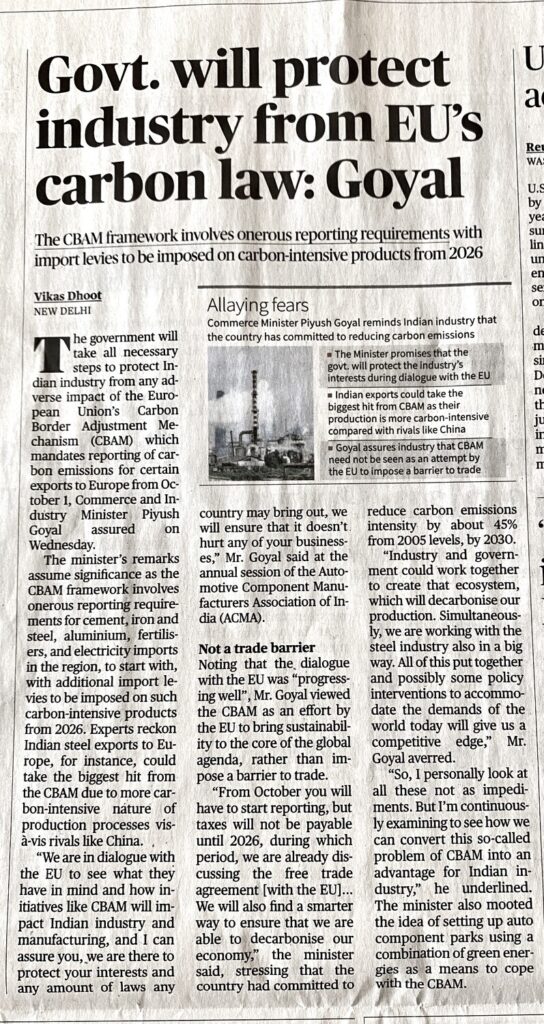
Courtesy: The Hindu, Business – 14th September 2023




Leave a Reply